
The complete guide
How To Choose And Use A Retractable Golf Swing Trainer
The gap between rounds is where swings go backwards
Most amateur golfers play once a week if they are lucky. Between Sunday afternoon and the following Saturday morning, nothing happens. The swing you ended with is not the swing you start with, because muscle memory fades fast and the old habits never really leave. They just sit there, waiting for you to stop paying attention.
That is the real problem a golf swing trainer solves. Not magic mechanics, not a secret move. Volume. If you can get a few hundred good rehearsals in across a week instead of zero, your swing drifts forward instead of back. The hard part has never been knowing that. It has been finding something you can actually swing in a hallway without putting a hole in the ceiling, and that does not need hauling to the garage first.
What this one actually does
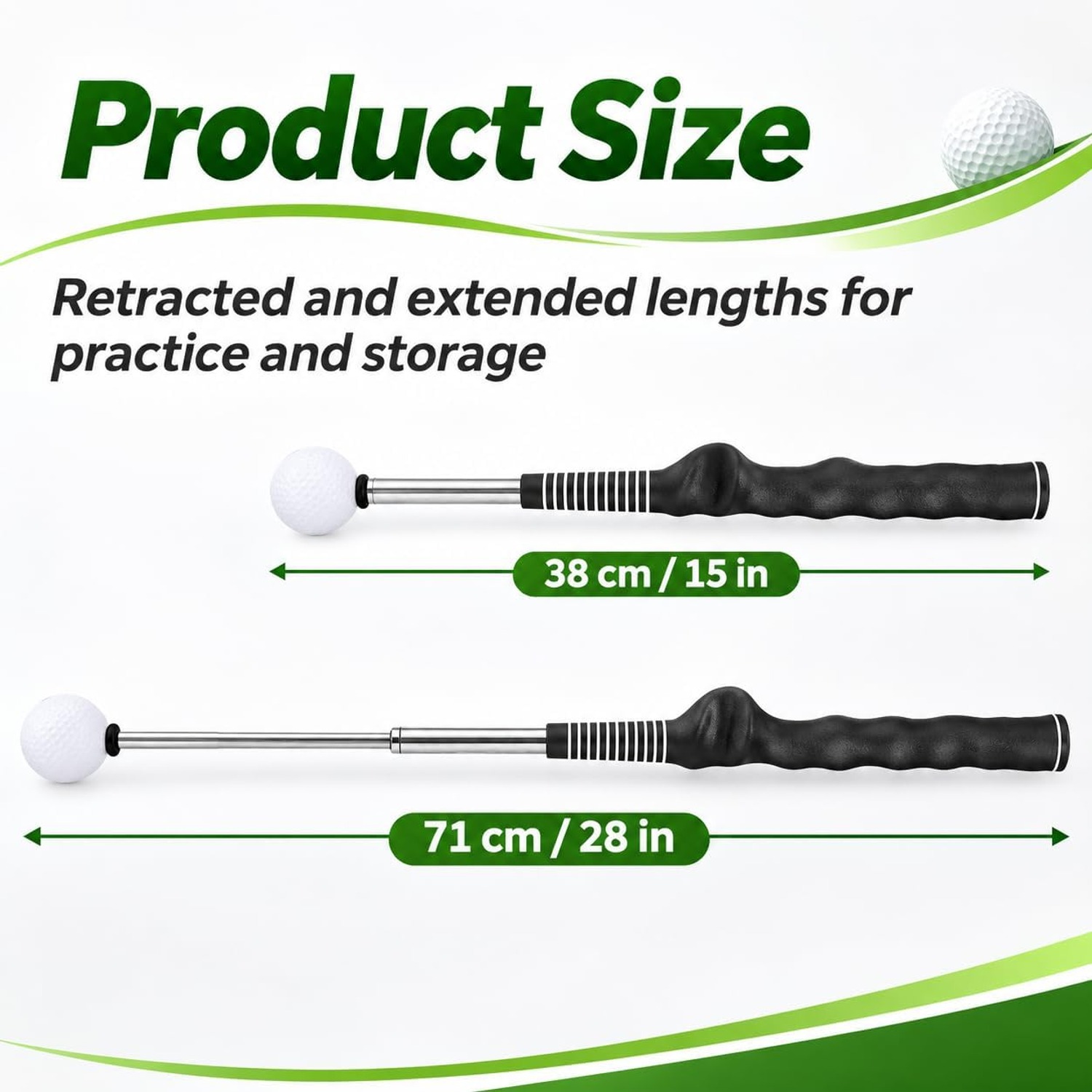
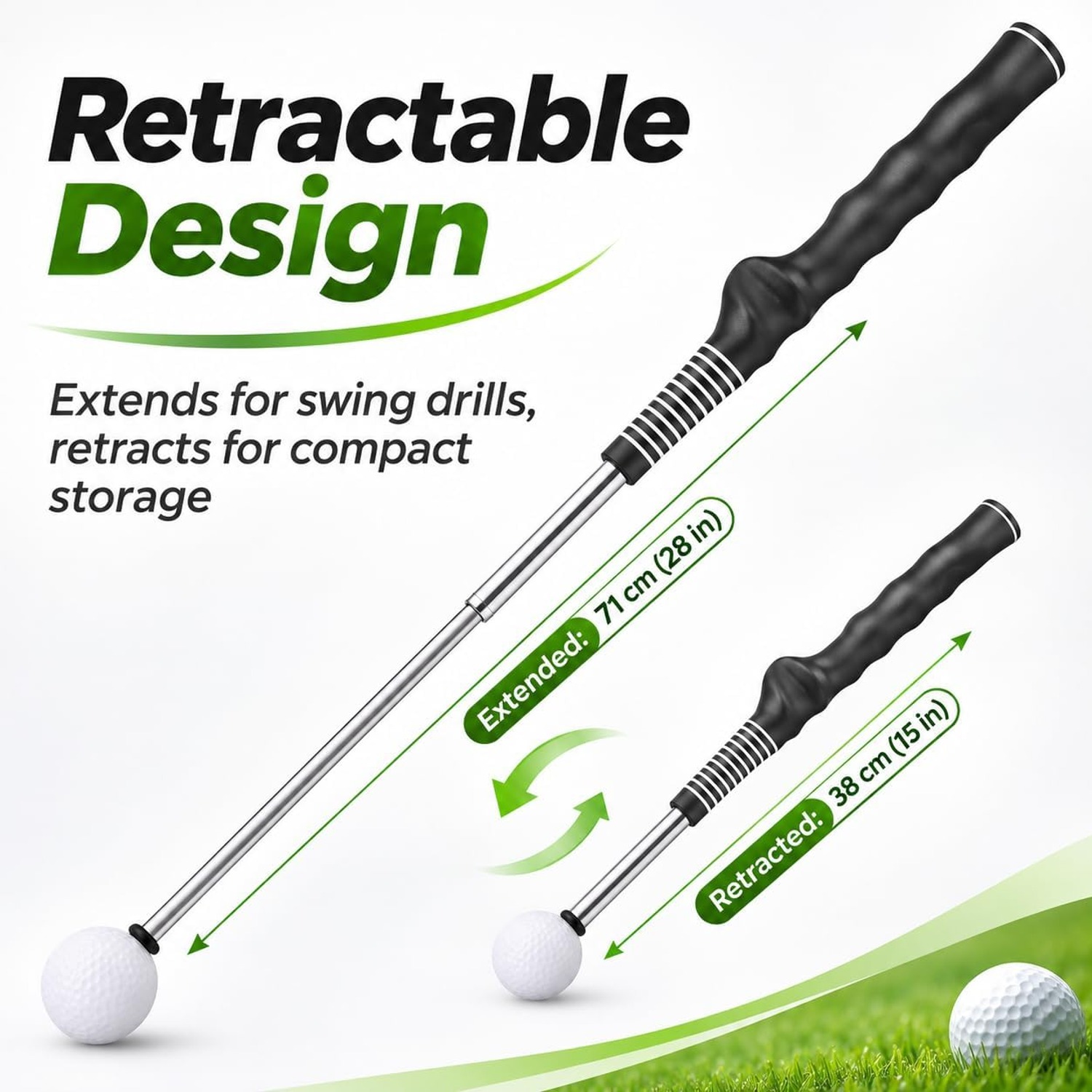
The shaft is telescopic. Retracted it sits at 38 cm, roughly the size of a long torch. Extended it locks out at 71 cm, which is enough to feel genuine arm and shoulder movement rather than a wristy flick. The change between the two takes about a second.
That sounds like a small thing. It is not. The single biggest predictor of whether a training aid helps you is whether you reach for it. Something that lives in a cupboard behind the Christmas decorations gets used twice. Something that sits by the back door, packs into a bag pocket and extends in a second gets used most days. Convenience is a feature, not a bonus.
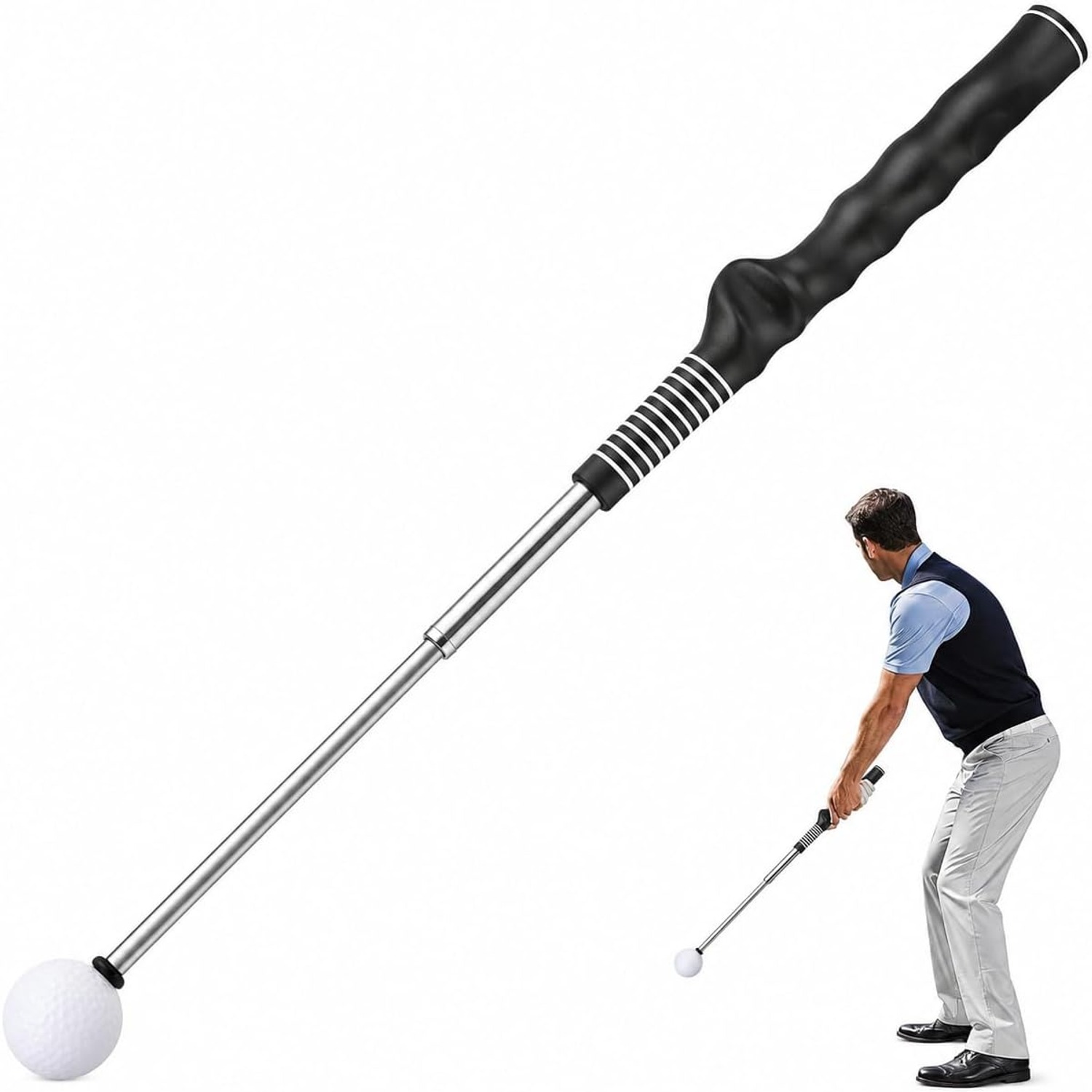
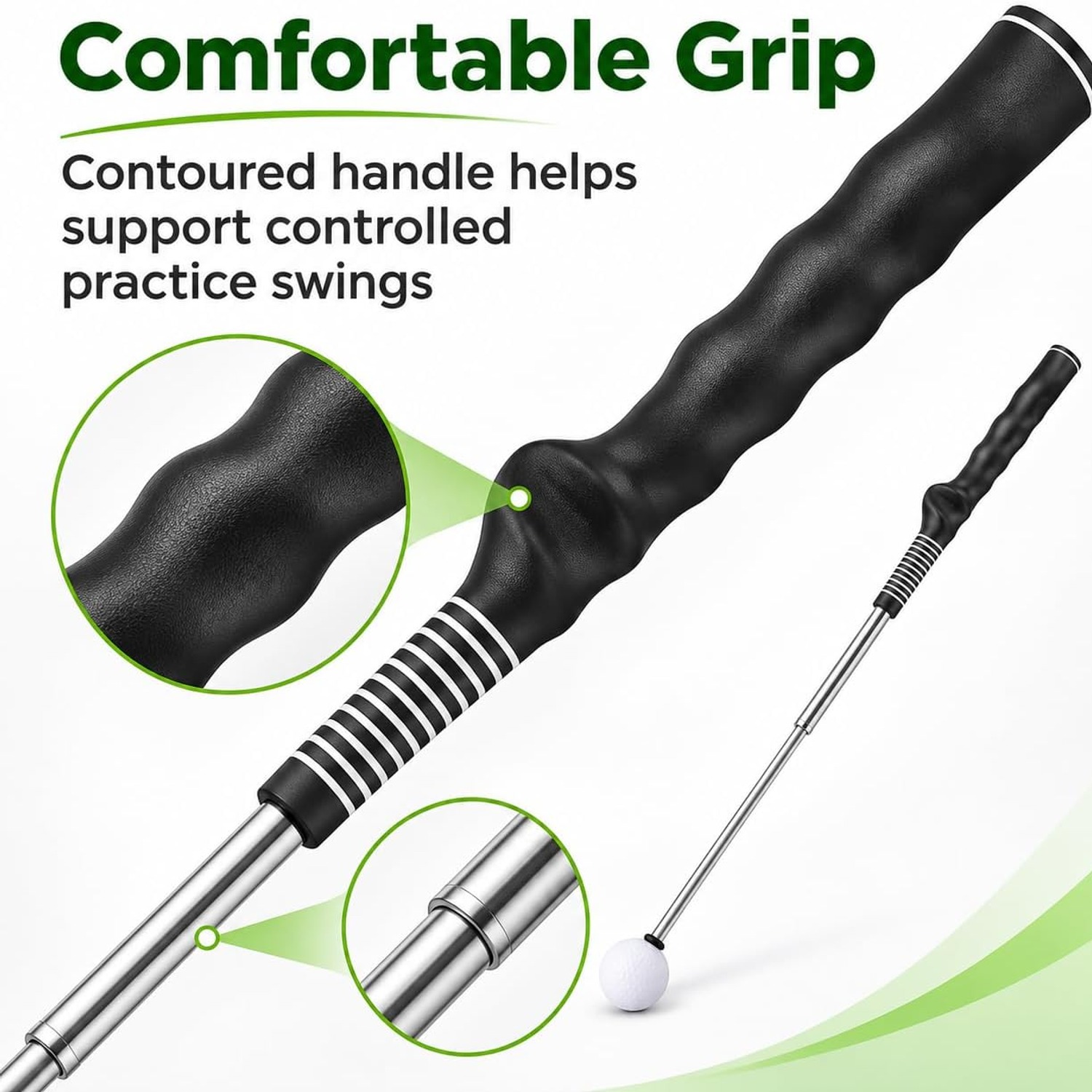
On the tip there is one white golf ball fixed to the stainless steel shaft. The handle at the other end is contoured black with a textured surface and a striped grip section. Materials across the unit are plastic, rubber and stainless steel. It is ambidextrous, so right and left handed players use the same thing.
Why the weight at the end matters
Swing an empty hand through the air and you feel almost nothing. Swing something with mass out at the tip and suddenly you can feel the whole sequence: the head trailing your hands on the way down, the moment it catches up, the release through the strike zone.
This is why the ball end earns its place. Golfers are told constantly to "feel the lag" or "let the club release", and those phrases are useless until you actually feel them. A weighted tip at the end of a 71 cm shaft gives the motion enough substance to sense. Go slowly at first. Fast swings with a training aid tend to reinforce whatever you already do, while slow rehearsals let you notice and change things.
A useful drill is the pause rehearsal. Swing to the top, stop for a full second, then start down slowly and feel which part of you moves first. If your hands and arms fire before your hips and torso, you will notice it immediately with weight at the tip. That awareness is most of the fix.
Grip work is the quiet win
Most players spend their practice time on the swing and almost none on the grip, which is backwards. Your hands are the only connection to the club. A grip that shifts by a few degrees between shots will change the face angle at impact more than most swing adjustments.
The contoured, textured handle on this trainer works as a golf grip trainer because it gives your hands a repeatable landing spot. The routine is simple. Set your hands, check them against your normal hold, swing, let go completely, then set them again from scratch. Do that twenty times and you will be surprised how often you drift. Do it for a fortnight and the drift mostly stops.
This is also the part you can do while the kettle boils, while something plays in the background, or standing in a hotel room. It does not need space, speed or focus the way full swing work does.
Choosing: what to look at before you buy
If you are comparing training aids, a few things matter more than the marketing.
Length when extended decides what you can rehearse. Anything much under 60 cm tends to encourage a short, armsy motion. At 71 cm you get a reasonable facsimile of a real swing arc.
Packed length decides whether you use it. A 38 cm collapsed length is the difference between it living in your bag and living in a drawer you never open.
Grip shape decides whether grip work is possible. A plain round tube teaches you nothing about hand position. A contoured, textured handle with a defined grip section gives you something to repeat.
Weight distribution decides what you feel. The mass should be at the tip, not spread evenly, because tip mass is what makes sequencing obvious.
Who it suits
Beginners get the most out of it, because they are building habits from scratch and every clean repetition counts double. The grip work alone saves months of guessing.
Mid handicappers use it for tempo. If your good rounds and bad rounds feel like two different players, tempo is usually the variable, and slow rehearsals at home are the cheapest way to steady it.
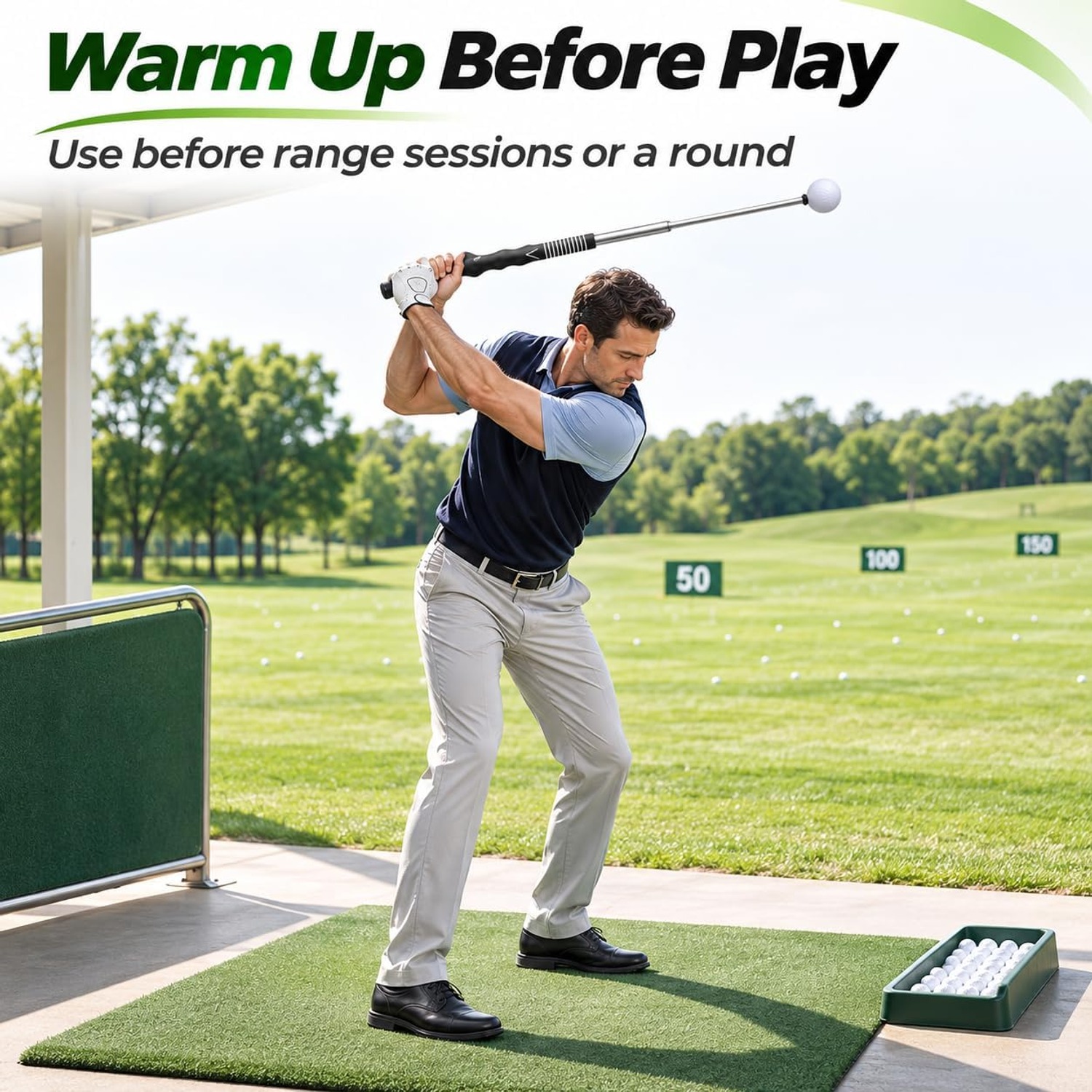
Low handicappers tend to use it as a warm up tool. Fifteen slow swings before the first tee beats walking onto the course cold, especially in winter.
Travelling golfers get the obvious benefit. A 300 gram, 38 cm package that fits a carry on means a work trip does not cost you two weeks of feel.
Using it safely indoors
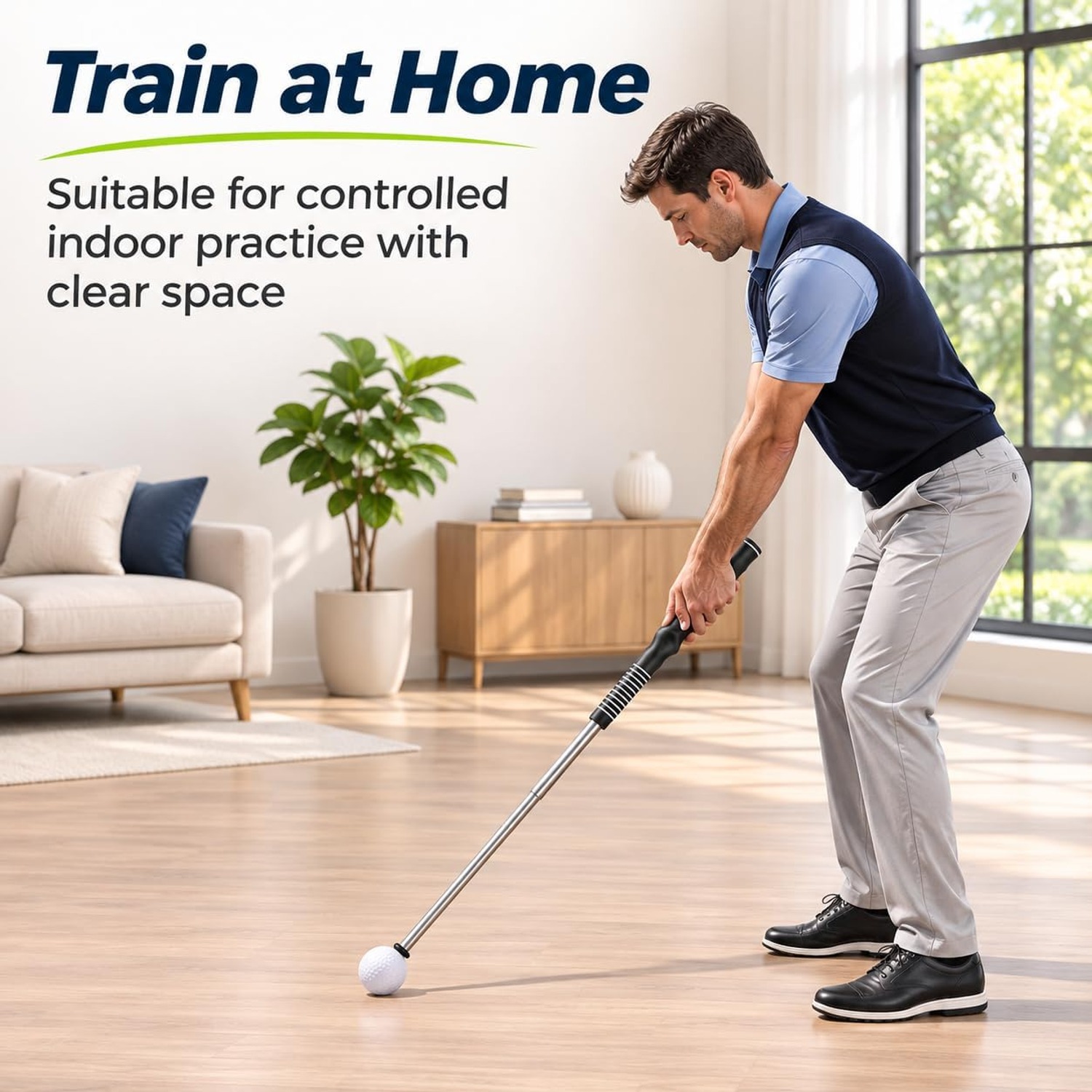
This part is not optional. You are swinging a 71 cm metal shaft with weight on the end. Before any indoor session, extend it fully and sweep a slow arc in every direction, including straight up and behind you. Check the ceiling, light fittings, fans, doorframes, screens, and anyone or anything within range.
Garages, hallways, carports and back yards are generally easier than living rooms. If the space is tight, stick to grip work and half swings, which still deliver most of the benefit. Keep children and pets clear. Common sense, but worth saying plainly.
Care and storage
Wipe the shaft, handle and ball end with a damp cloth after outdoor use and dry it properly before retracting. The reason is grit. Sand and dust that get inside the telescopic sections will eventually make the extend and retract action gritty, and that is the main thing that shortens the life of any telescopic product.
Store it retracted. Keep it out of direct sun and away from damp. Before each session, extend it and give it a firm check that the sections are seated and locked. If something feels loose or starts slipping under a swing, stop and inspect it rather than pushing through.
Building a routine that sticks
Pick a trigger. Most people fail at home practice because they wait to feel motivated. Instead, attach it to something you already do: after the morning coffee, before dinner, when you get home from work. Five to ten minutes is plenty.
A reasonable session looks like two minutes of grip setting and resetting, three minutes of slow half swings focused on sequence, and a couple of minutes of smooth full length rehearsals. Stop while it still feels good. Grinding until you are tired just teaches you a tired swing.
Track it loosely. A mark on a calendar for each day you picked it up is enough. Twenty marks in a month will show up in your ball striking, and that is a far better feedback loop than hoping something feels different next Saturday.
The short version
This is a 71 cm telescopic golf swing trainer that collapses to 38 cm, with a weighted ball end for feel and a contoured textured handle for grip work. It is ambidextrous, light at 300 grams packed, and made from plastic, rubber and stainless steel.
It will not rebuild your swing on its own. What it will do is make daily rehearsal easy enough that you actually do it, at home, at the range, or wherever you happen to be. That consistency is what moves scores, and it is the thing most golfers never manage because their training gear is too awkward to bother with. Check your clearance, keep it somewhere you will see it, and give it ten minutes a day.