
The complete guide
How to Choose a Golf Practice Net for Home
The practice problem nobody talks about
Ask most club golfers why their swing has not improved in three years and you will hear the same answer in different words. Not enough practice. Not lack of interest, not lack of lessons, just time. A range session is rarely only a range session. It is the drive there, the wait for a bay, the bucket, the drive home. Ninety minutes gone for forty balls.
Meanwhile there is a perfectly good patch of grass twenty steps from the back door. The only thing stopping you using it is where the ball goes afterwards.
That is the gap a backyard golf net fills. It gives the ball somewhere safe to land so you can keep swinging without stopping to look. Twenty minutes after work becomes a real practice session instead of a thought you had on the drive home.
How a hitting net actually works
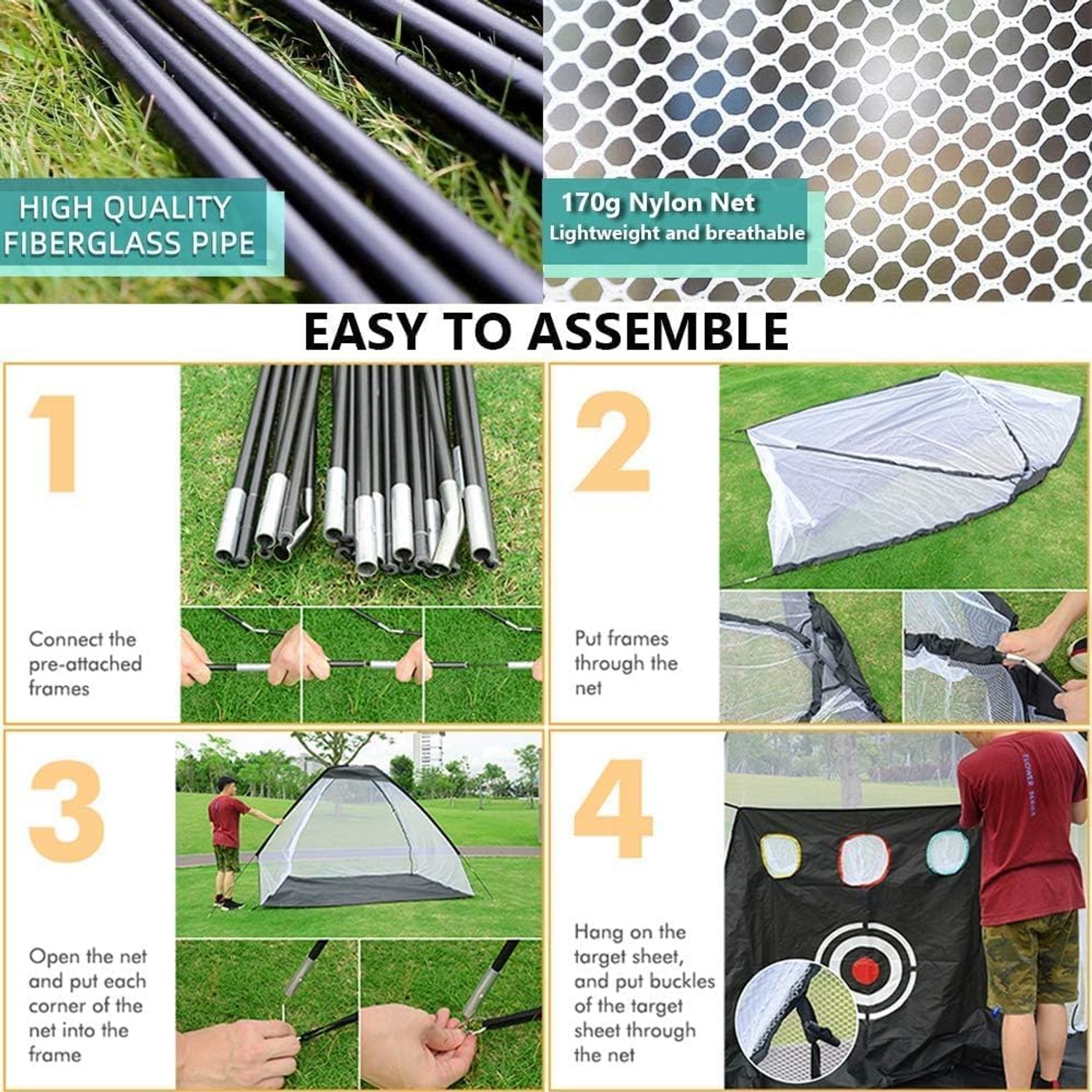
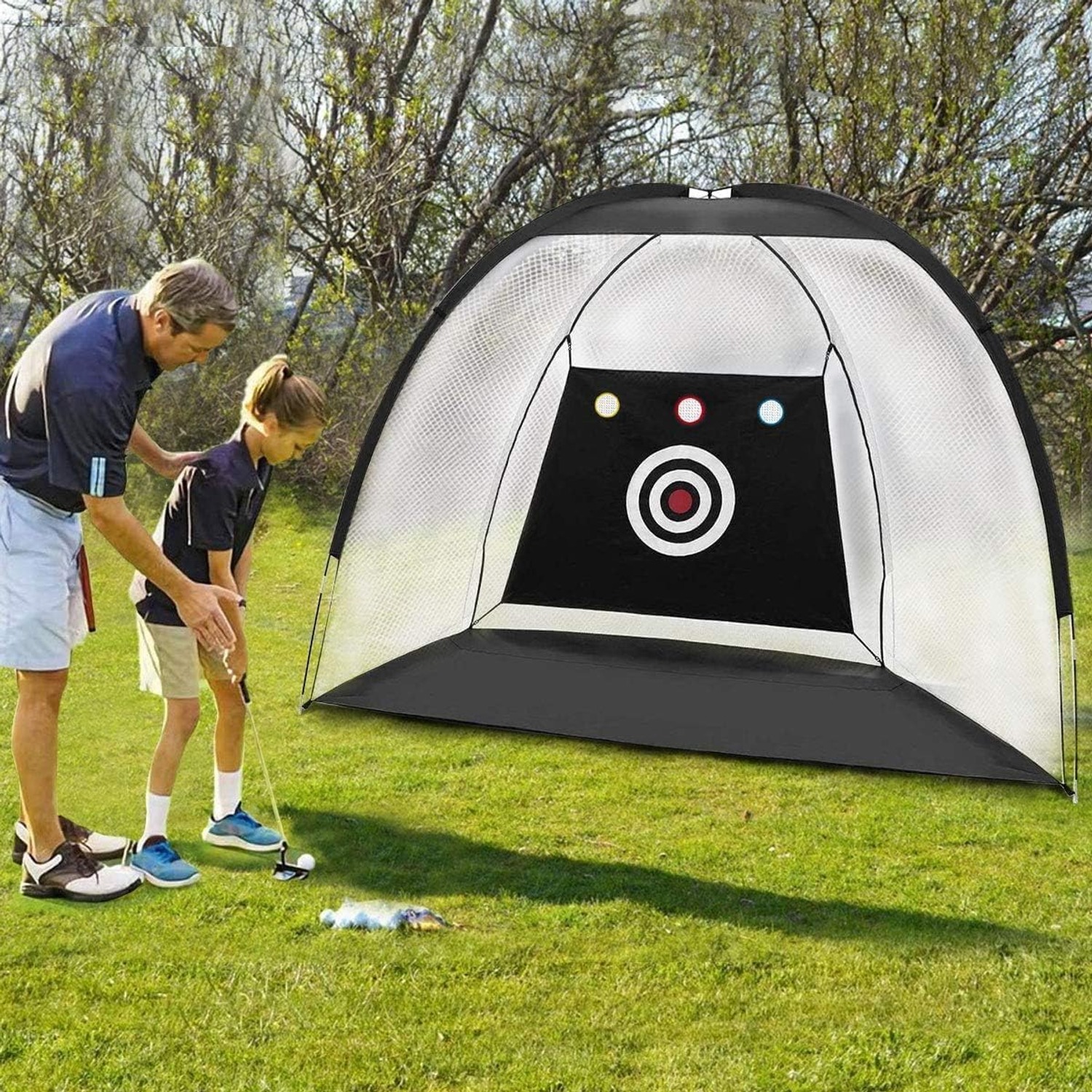
The mechanics are simpler than people expect. A fibreglass frame holds a panel of nylon mesh upright in a wide rectangle. You hit into the mesh, the mesh flexes and absorbs the energy of the strike, and the ball drops at the base instead of coming back at you.
Nylon is used because it gives. A rigid surface would send the ball straight back, which is both alarming and a good way to break something. The flex is the safety feature.
The frame on this set comes pre-attached to the net, which removes the fiddliest part of assembly. You extend the poles, seat the four corners, peg the base and you are done. People who have wrestled with a tent at a campsite will understand why this matters. A net that takes fifteen minutes to put up gets used once a month. A net that takes two minutes gets used on a Tuesday.
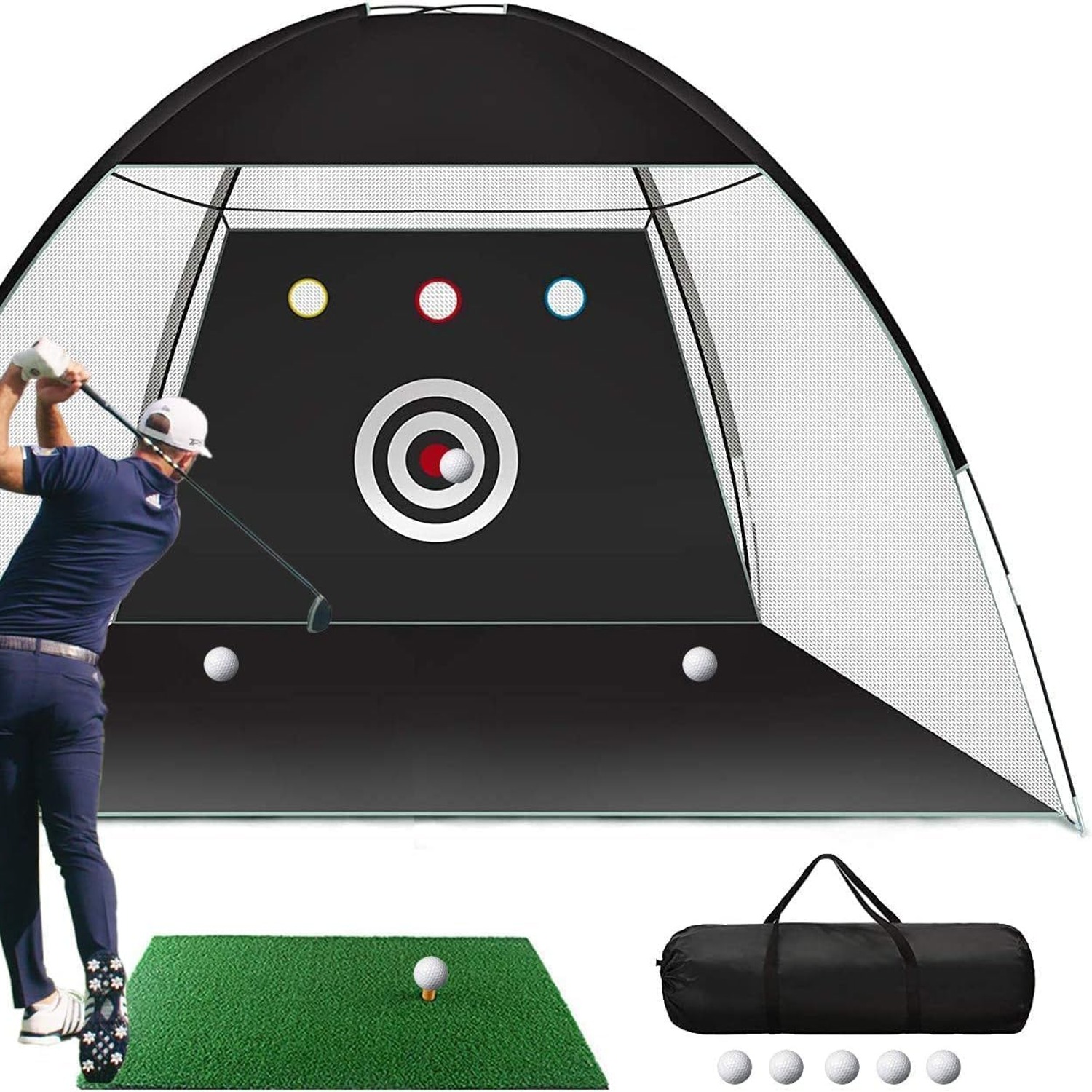
The target sheet hangs on the front with elastic loops at the corners. It has one large pocket in the middle and three smaller chipping pockets. Hitting into a blank net is fine for grooving a motion, but it tells you nothing about aim. A target tells you whether the ball started where you wanted.
Who this suits
Golfers short on time. If your practice happens in gaps rather than blocks, a home net pays for itself quickly in range fees alone.
Beginners. Early improvement comes from volume. Hitting two hundred balls a week in the yard will do more for a new golfer than one supervised bucket a fortnight. The included mat and balls mean there is nothing else to organise.
Short game players. The chipping pockets make this useful well beyond driver practice. Most strokes are lost inside a hundred metres, and that is exactly the range a target sheet rewards.
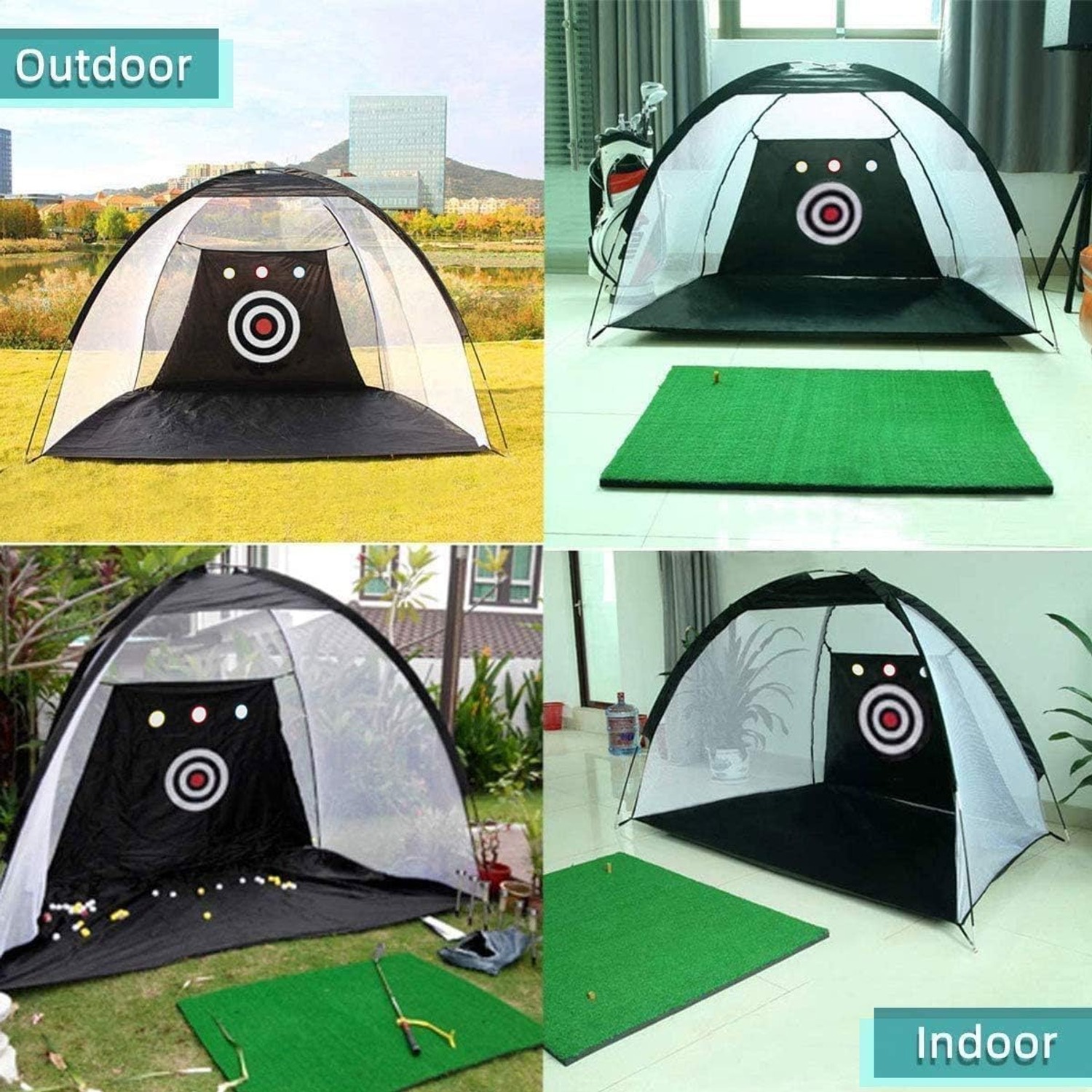
People who move their practice around. The carry bag means this can live in the garage through winter and the yard through summer, or travel to a holiday house.
It suits you less well if your only space is a narrow balcony or a room with low ceilings. The listed size is 10 x 8 x 7 ft and you need headroom for your longest club on top of that.
Measuring your space before you buy
This is the step people skip and regret. Take a tape measure outside and mark out the footprint on the ground. Then stand where you would hit from and take a slow full swing with a driver, no ball. Watch the clubhead through the whole arc.
Three things to check:
- Height. Indoors, the ceiling. Outdoors, branches, gutters and washing lines. The top of the arc is higher than most people guess.
- Behind you. You need room for a full backswing with space to spare. Windows, cars and parked bikes should be nowhere near the line.
- Beyond the net. Nets are reliable, but assume the occasional ball gets through or deflects. Do not set up firing at the neighbour's glass sliding door.
If you are tight on space, that is not necessarily a no. You can set the net up for wedges and chipping and still get real value from it. Driver practice simply needs more room.
Getting the most from each session
A net removes the ball flight, and some golfers find that strange at first. You cannot see where the shot ended up. The trick is to shift what you are measuring.
Watch the strike instead. Where on the face did it hit? Did the contact feel thin or fat? Put a dry-erase marker or foot spray on the face occasionally and you will get a clear picture of your pattern.
Use the target sheet for start line. If you are aiming at the centre pocket and consistently finding the left side, that is useful information that has nothing to do with how far it went.
Work in short blocks. Ten balls with one intention beats sixty balls with none. Most people get more from fifteen focused minutes in the yard than an hour of mindless bucket-emptying at the range.
And use the mat. Hitting off the same surface every time removes a variable, so when something changes you know it was you and not the lie.
Looking after it
Nylon netting has one enemy above all others, and that is sunlight. Constant UV weakens the fibres over time. The single best thing you can do is pack the net into its bag after each session rather than leaving it standing in the yard all summer.
Damp is the second issue. If the net is wet when you fold it, leave it open somewhere airy until it dries properly. Folding wet nylon into a closed bag produces a smell that never fully goes away.
Beyond that, maintenance is light. Shake off grass clippings, wipe the poles down occasionally and keep an eye on the centre of the hitting area where most strikes land. If you spot a fray, keep watching it. Mesh damage spreads under repeated impact, and a net with a hole through it is no longer doing its job.
Check the frame too. Fibreglass poles are tough but they can split if the net is forced into shape or packed carelessly. Ease the sections apart rather than yanking them.
Setting it up outdoors
Peg all four base points firmly. On soft ground this is straightforward. On hard summer ground you may need to pre-wet the area or use weights instead.
Wind deserves a mention. A net is a large flat surface, which makes it a sail. Pack it away if a strong blow is forecast rather than hoping the pegs hold. Taking it down is a two-minute job and much cheaper than replacing a bent frame.
Angle matters slightly. A net set perfectly square to your target line catches the widest range of shots. If the ground slopes, work out which direction the base wants to slide and peg that side harder.
The short version
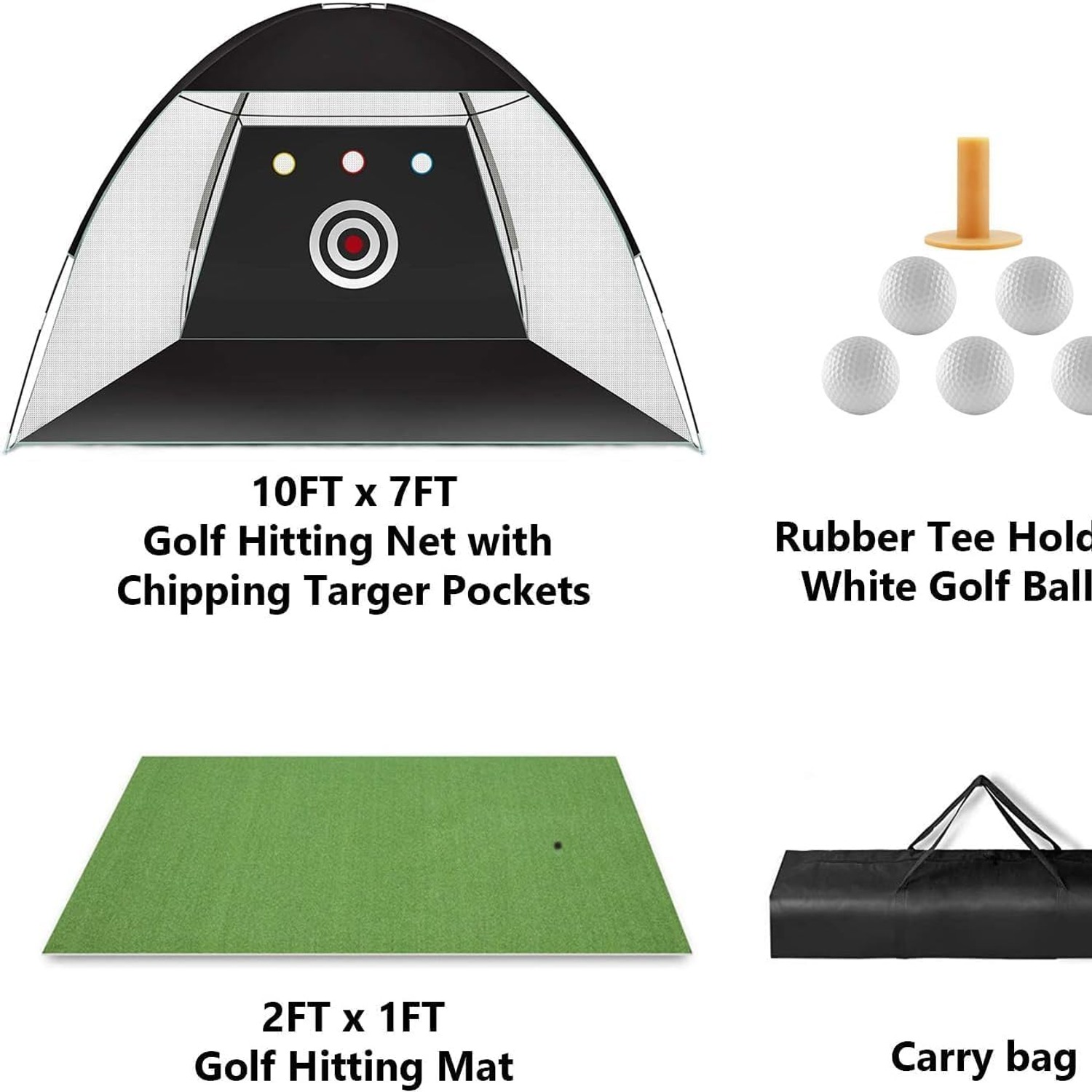
A golf practice net is the cheapest way to turn dead time into practice time. This one arrives as a complete set, with the net, a target sheet with chipping pockets, a grass mat, five balls, a tee and a carry bag, so there is nothing missing on the first day.
The hitting area is generous at a listed 10 x 8 x 7 ft, the mesh is nylon over a fibreglass frame, and the pre-attached frames keep setup quick enough that you will actually bother.
Measure your space first, peg it down properly, pack it away when you are done, and it will give you a lot of swings for the money. The rest is just showing up.