
The complete guide
How to Choose a Golf Hitting Mat for Home Practice
The problem with waiting for range time
Ask most club golfers why their handicap has stalled and the honest answer is volume. They play a round at the weekend, maybe hit a bucket of balls once a fortnight, and then wonder why the same miss keeps showing up. Golf is a motor skill. Motor skills need frequent, short, repeated practice, not occasional long sessions separated by two weeks of nothing.
The barrier is almost never motivation. It is logistics. The range is a twenty-minute drive, it closes before you finish work, and a decent bucket costs real money. Meanwhile there is a perfectly good patch of lawn, driveway, or garage floor sitting unused at home.
A golf hitting mat is the piece that unlocks that space. It gives you a consistent striking surface that will not tear up your lawn, chew your club soles, or jar your wrists. Ten minutes before dinner becomes a usable practice session. Over a season, those ten-minute blocks add up to more swings than you would ever squeeze in at a range.
How a dual turf mat works
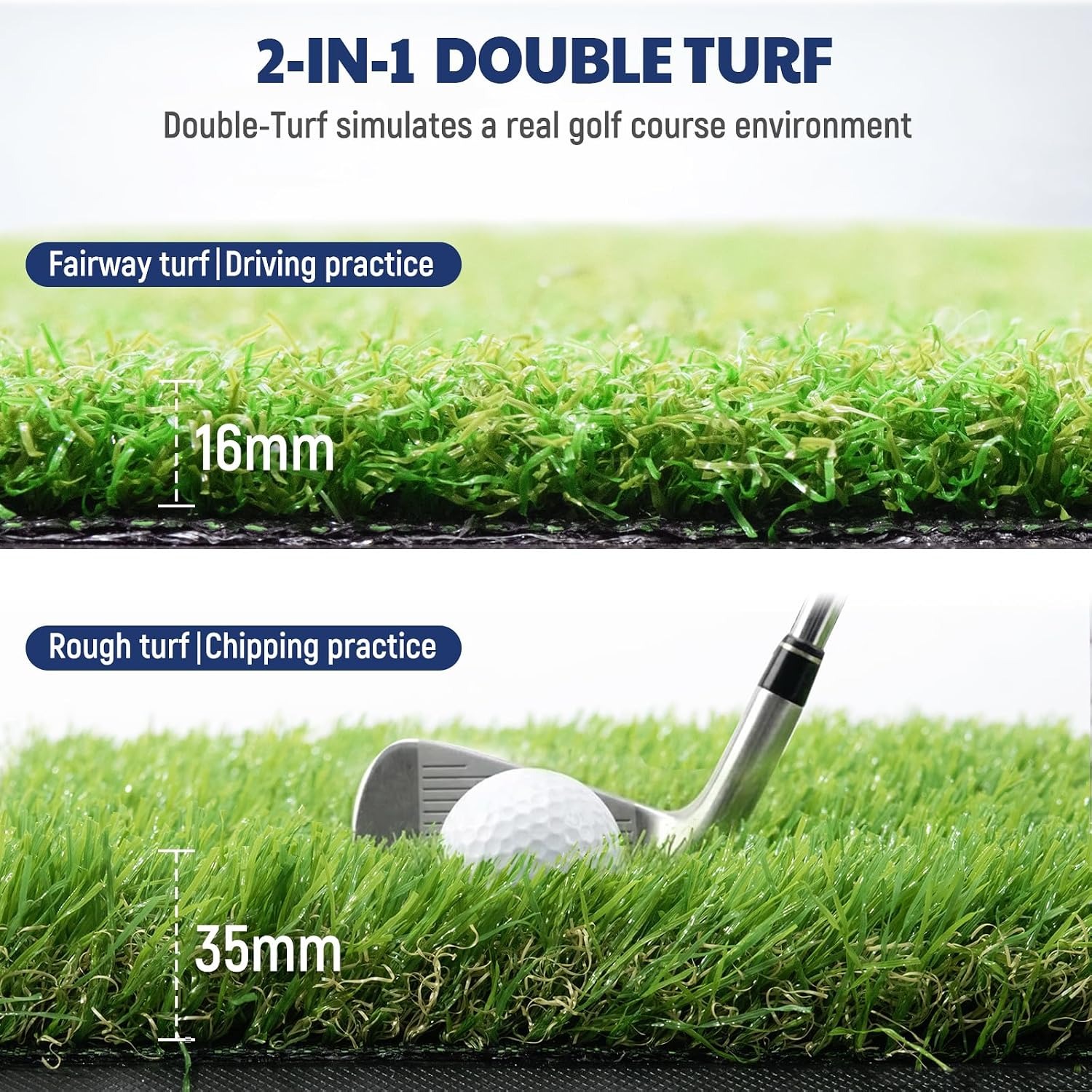
A single-surface mat is fine for one thing. Hit off a short, tight pile and you get a fairway-style lie. That is useful for irons and tee shots, but it teaches you nothing about how the club behaves when there is grass between the face and the ball.
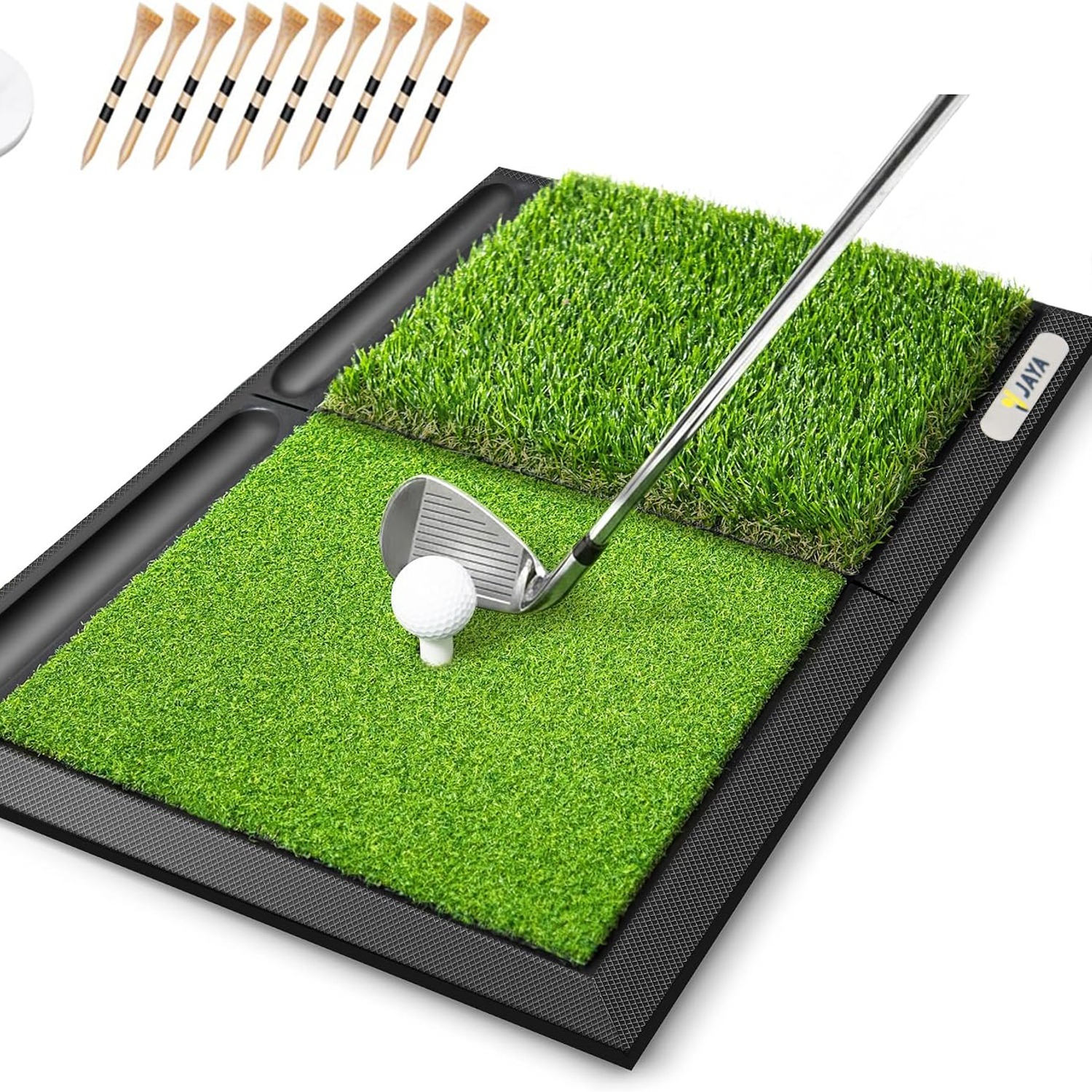
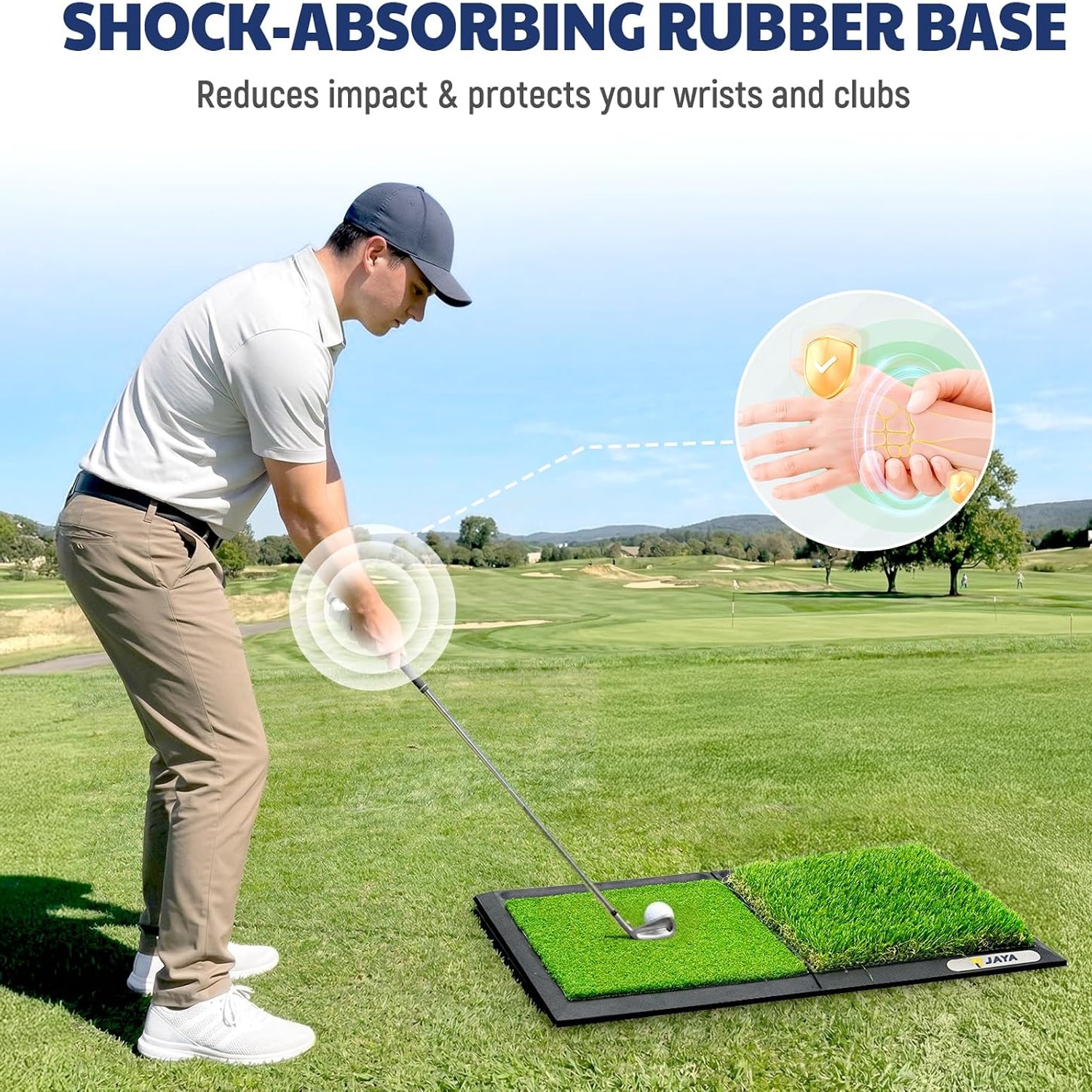
This mat splits the surface in two. One area carries a longer grass pile, similar to a light rough or fringe lie. The other has a short, tight pile for clean contact. In practice that means you can run a session like a real round. A few wedges from the longer stuff, then move across to the short side for mid-irons, then back for chip shots to finish.
The longer pile does something specific for your short game. When the club has to pass through grass, deceleration shows up immediately. The ball comes out short and heavy. On a tight mat you can get away with a lazy chip because the sole just skids. On the long pile you cannot, which is exactly why it is useful.
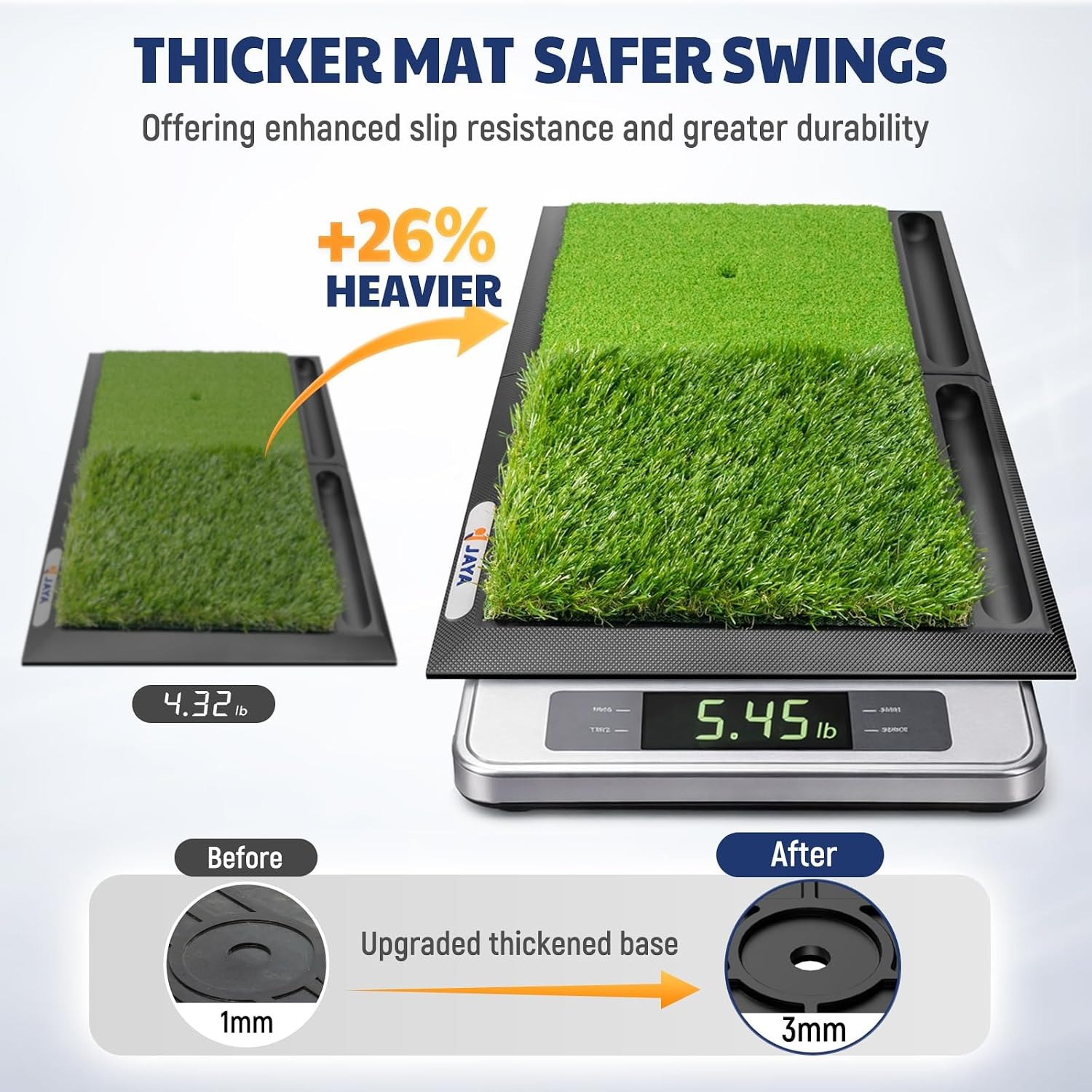
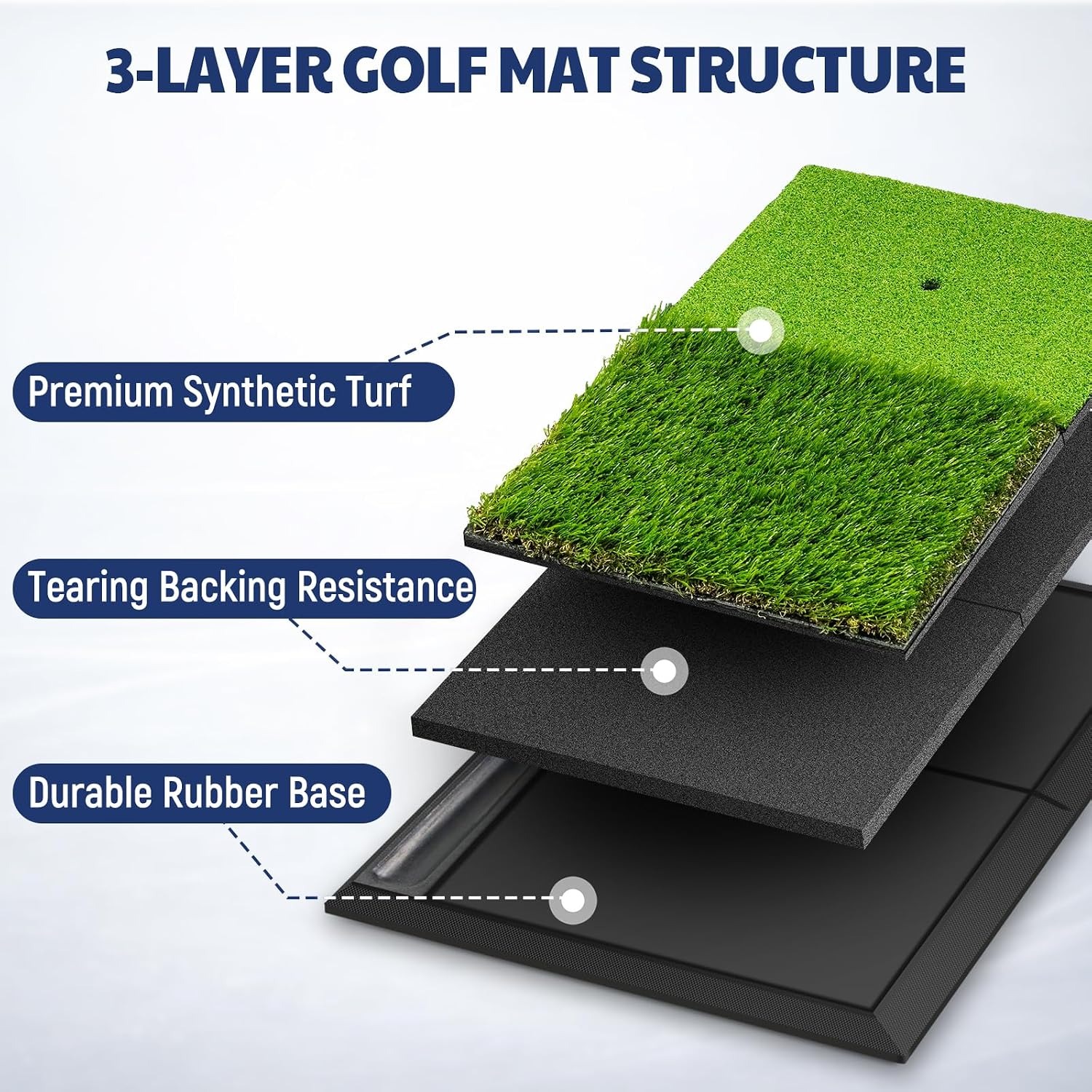
Underneath both surfaces sits a weighted three-layer rubber base with a textured bottom. Two jobs there. First, it stops the mat creeping forward every time you strike down on a ball, which is the single most annoying trait of a cheap mat. Second, it absorbs impact. Hitting slightly behind the ball on a hard driveway sends a shock straight up the shaft. Rubber takes the edge off that, which your elbows will appreciate after fifty swings.
The ball tray matters more than you think
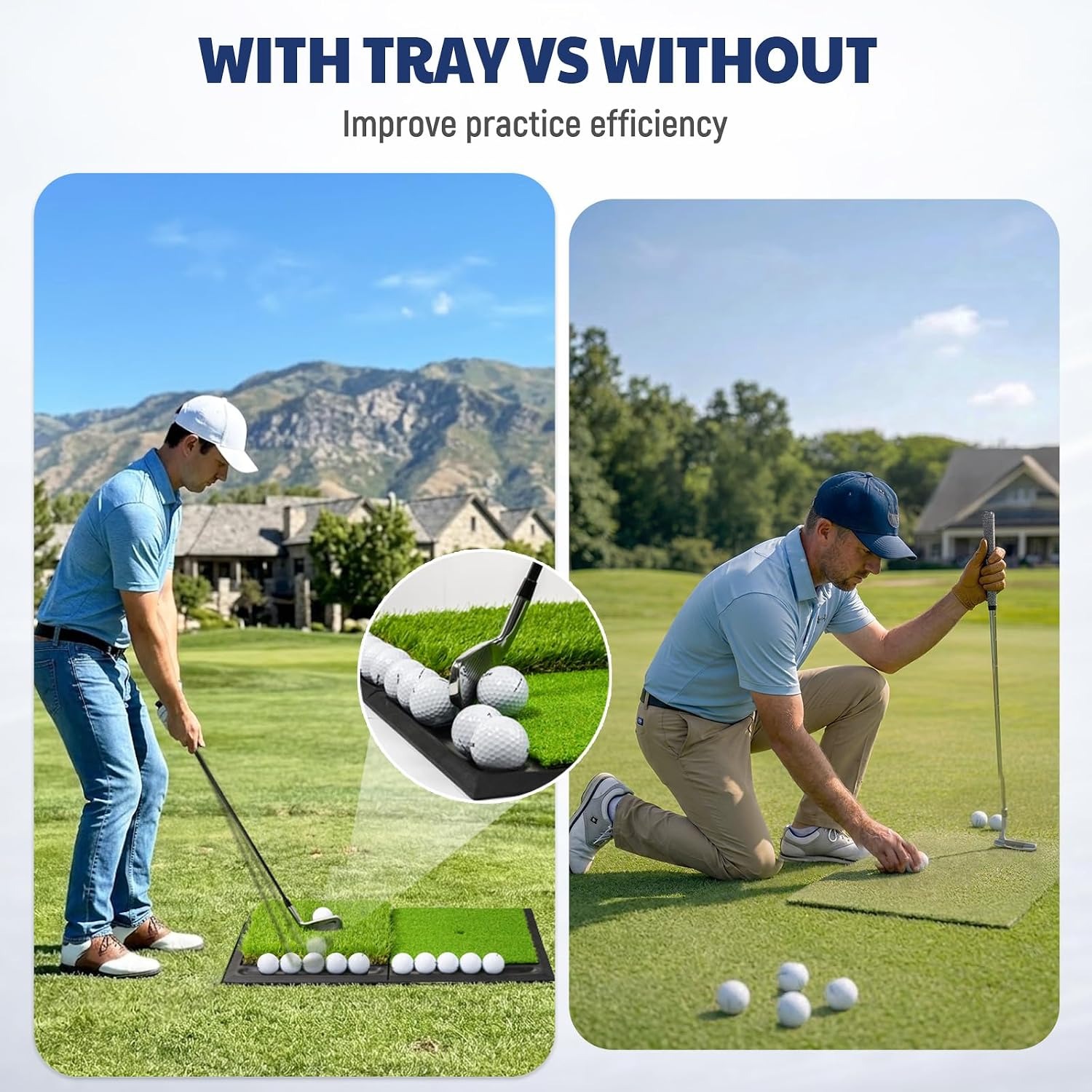
The rubber ball tray holds up to 12 balls and sits right beside the hitting zone. It sounds like a small feature. In use, it changes the whole rhythm of a session.
Without a tray, every shot involves reaching into a bucket, bending, placing, and resetting. That is four or five seconds of faff per ball, and it breaks the flow of whatever you were working on. With the tray, you drag the next ball across with the club head and you are set up again in a second. More balls in the same time, and far better continuity when you are trying to groove a feel.
It also keeps balls from scattering. If you practise on a lawn or a driveway that slopes, loose balls end up under the car or in the flower bed. The tray keeps them where you left them.
Who this mat suits
This is a mat for people with limited space and limited time. At 25 by 17 inches, it fits in a garage, on a patio, down the side of a house, or in a basement with enough ceiling. It is not a full stance mat where both feet stand on turf, so you will be standing on whatever surface you have placed it on. For most home setups that is completely fine, as long as the ground is level.
It suits beginners well. New golfers improve fastest with repetition, and a mat at home removes every excuse. The long turf side is particularly valuable here, because short game is where most beginners bleed strokes and it is the easiest area to practise quietly at home.
Experienced players use it differently, usually for maintenance. Fifteen minutes of wedges in the evening keeps the hands sharp between rounds. Some use it purely as a winter tool when courses are soft and ranges are miserable.
It also works for anyone building a net setup. Put the mat at the right distance from a practice net and you have a functioning home bay. If space is the limiting factor, this is one of the better options for the best backyard golf mat on a modest footprint.
What to look for when you compare mats
Base construction. This is the thing that separates a mat that lasts from one that curls and slides. Weight and a textured rubber bottom are what you want. A thin mat with a smooth back will travel across the floor and frustrate you within a week.
Edge finish. Turf mats almost always fail at the corners first, where the fibre layer lifts away from the backing. Sloped edges, like the ones on this mat, help keep that join protected and reduce peeling.
Cushioning. If you plan to hit off concrete, cushioning is not optional. The rubber layer here is what makes driveway practice realistic rather than painful.
Surface variety. One lie teaches one shot. Two surfaces give you a genuine range of practice without buying a second mat.
Storage. A foldable mat that weighs 2.09 kg can live in a cupboard. A heavy fixed slab needs a permanent home. Think about where it goes between sessions before you buy.
Extras. Tees and a tee holder sound minor until you want to hit a driver and realise you have no way to set a tee on a mat. Ten tees and a rubber holder come in the box here.
Setting up a practice space
Start with level ground. A slope under the mat changes your contact in ways you will not notice until your ball flight goes odd. Pavers, a flat driveway, a garage floor, or firm level lawn all work.
Check your swing clearance in every direction, including behind you and above. Garage practice ends badly when a backswing meets a light fitting. Measure once with a 7-iron and once with a driver.
If you are hitting into a net, give the ball enough distance to rise before it hits the mesh. Too close and balls come back at you. Too far and you lose the space. Most nets specify a recommended distance, so follow it.
Keep a target. Even indoors, aim at a specific point on the net. Practising without a target is how people grind out bad habits at speed.
Looking after it
Care is simple. Brush or shake off grass clippings and dirt after each use so grit does not work into the base of the fibres. If it gets muddy, a damp cloth with mild soap handles it, then let it dry fully before it goes away.
Store it under cover. Sun and rain over months will degrade any turf mat, and there is no reason to leave it out when it weighs 2.09 kg and folds. When you put it away, rolling is kinder than folding hard along the same line every time, because repeated sharp creases eventually mark the turf.
Rotate which part of the surface you hit from. Everyone has a favourite spot, and that spot wears first. Moving your ball position a few centimetres each session spreads the wear.
The short version
If you want to get better at golf and you cannot get to a range regularly, a hitting mat is the highest-value piece of equipment you can buy after clubs. This one gives you two turf surfaces instead of one, a 12-ball rubber tray that keeps your rhythm going, a weighted three-layer base that stays put, and ten tees with a holder so you can work on everything from chips to drivers.
It measures 25 by 17 inches, weighs 2.09 kg, folds away, and is built from rubber. Set it up somewhere level, give yourself room to swing, and use it for ten minutes at a time rather than an hour once a month. That is how the scores actually come down.