
The complete guide
The Buyer's Guide to Choosing a Golf Divot Tool
The small problem nobody warns you about
You hit a good approach shot. The ball lands on the green, takes a bite out of the turf, and stops near the pin. Lovely. Then you walk up and realise you have made a crater, and the person who played the hole before you made one too, and nobody fixed either of them.
Unrepaired pitch marks are the single biggest cause of bumpy greens. A mark that gets fixed properly within a few minutes heals in roughly a day. One left alone can take three weeks to recover and often leaves a permanent dead spot. Multiply that by two hundred rounds a week at a busy club and you can see why greenkeepers get grumpy.
So the fix is simple. Carry a tool, use it every hole. The reason most golfers do not is equally simple, and it has nothing to do with laziness. It is that the standard two-prong repair fork is genuinely irritating to carry around.
Why pocket comfort decides whether you actually use it
Think about where a divot tool lives. Front trouser pocket, usually, alongside a tee, a ball and maybe a phone. A fixed fork has two sharp prongs pointing outward at all times. They catch the pocket lining, they snag the fabric when you pull your hand out, and sooner or later they poke a finger. Give it a season and you have a small hole in your golf trousers.
What happens next is predictable. The tool migrates to a zipped bag pocket where it cannot do damage, which means it is forty metres away on the tee box when you need it on the green. You stop bothering. The marks stay unrepaired.
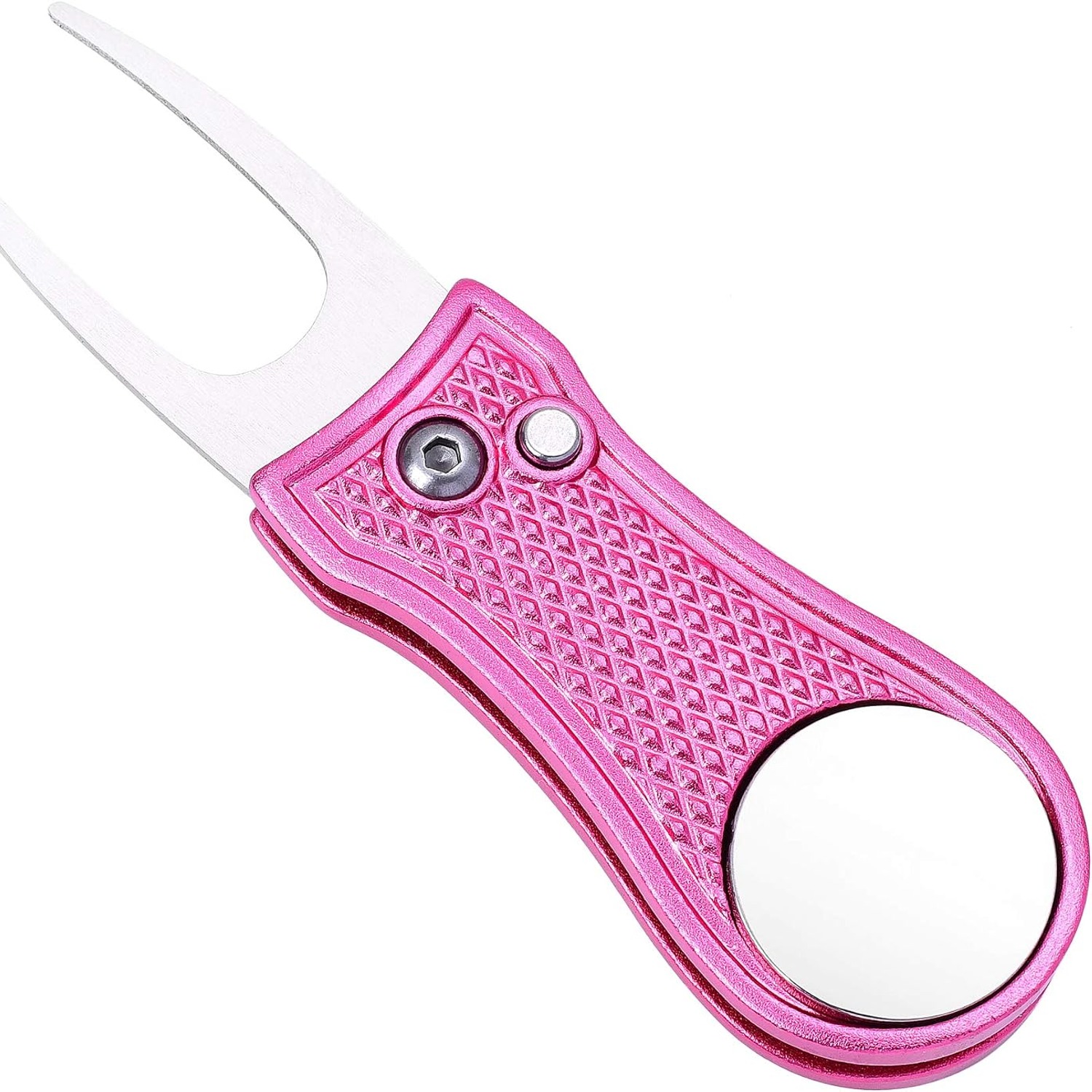
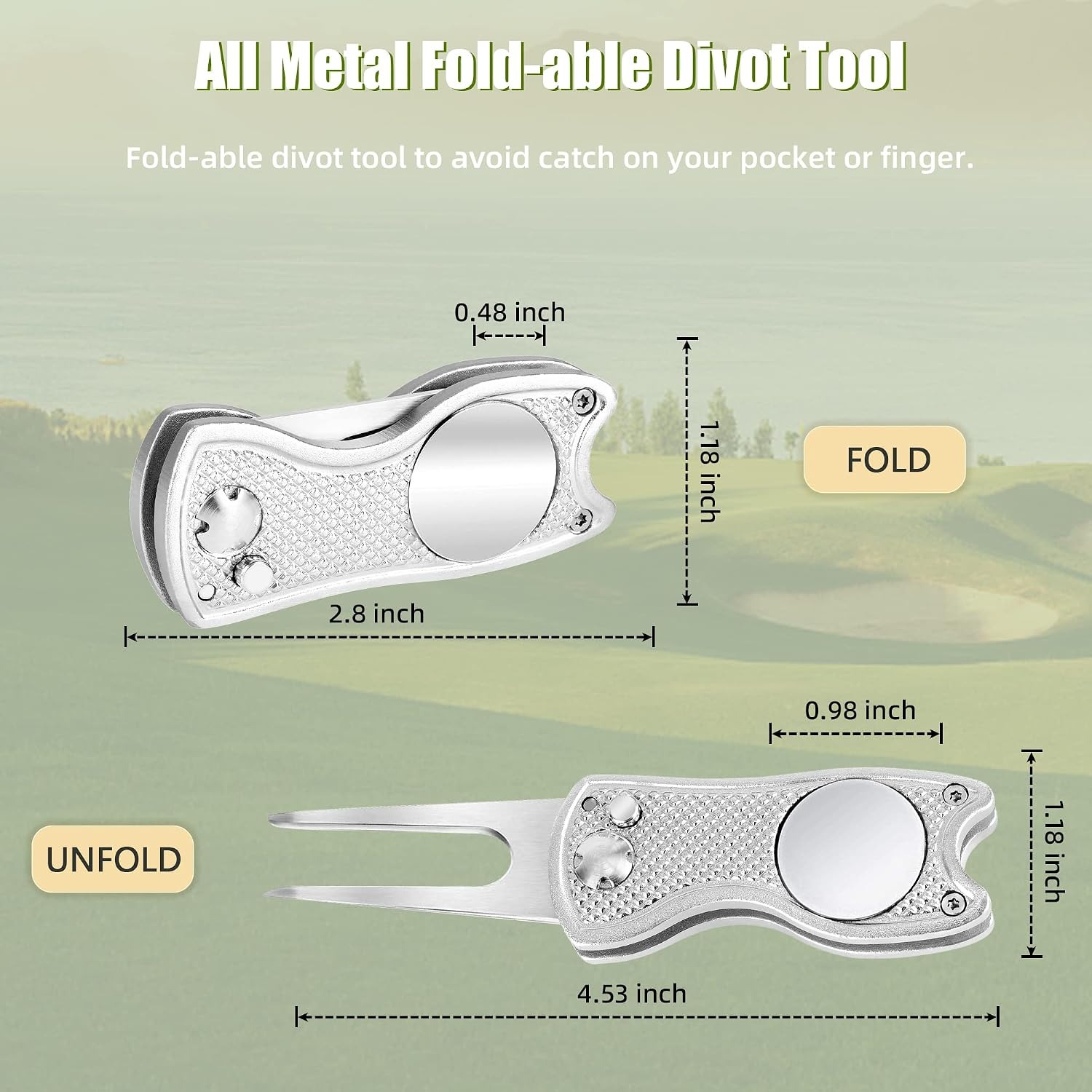
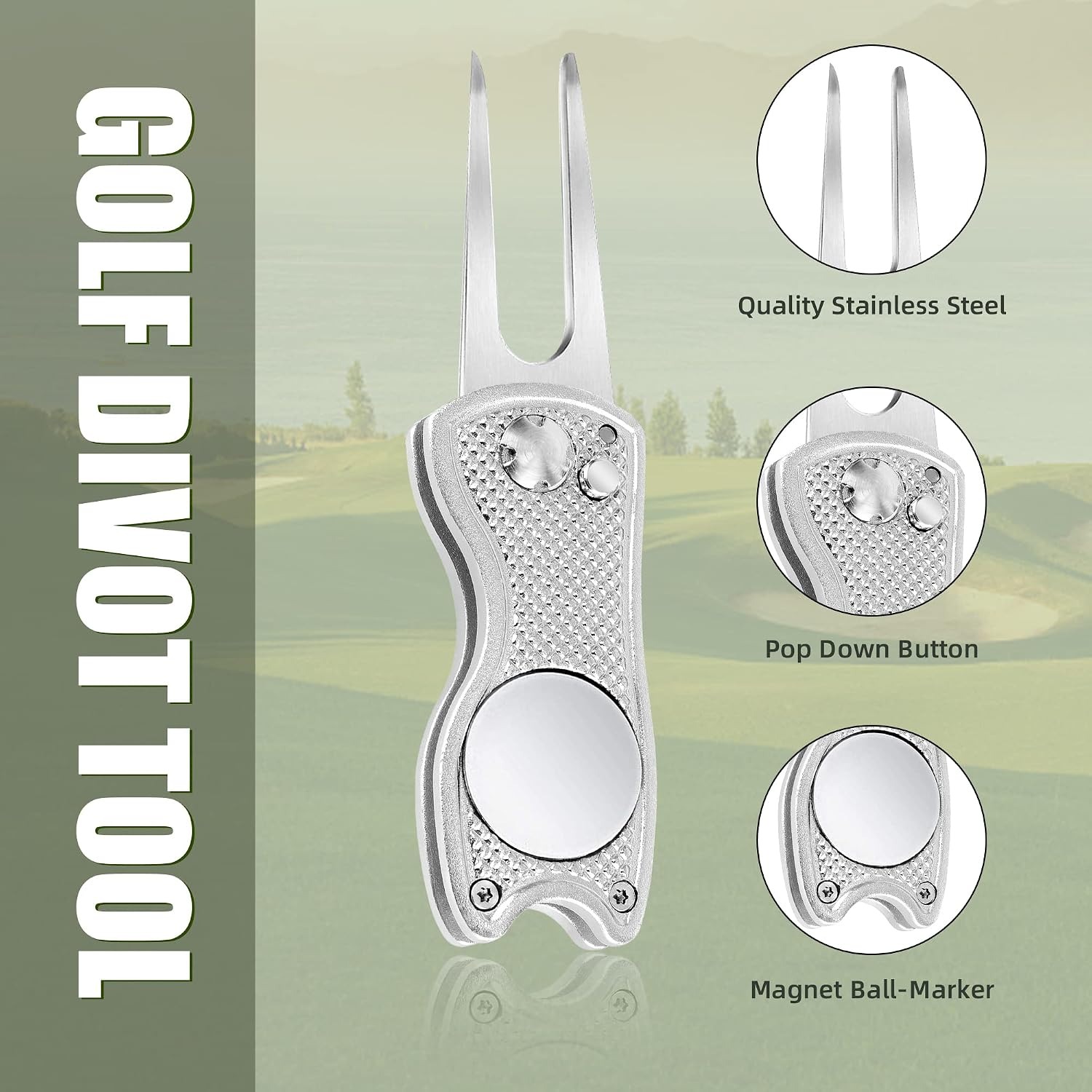
A foldable divot tool removes that whole chain of events. The fork lives inside the handle. Press the button, it pops out. Push it back in when you have finished. In your pocket, the tool is a smooth, flat lump of metal with nothing to catch on. That is why the folding design matters more than it sounds.
How this one works
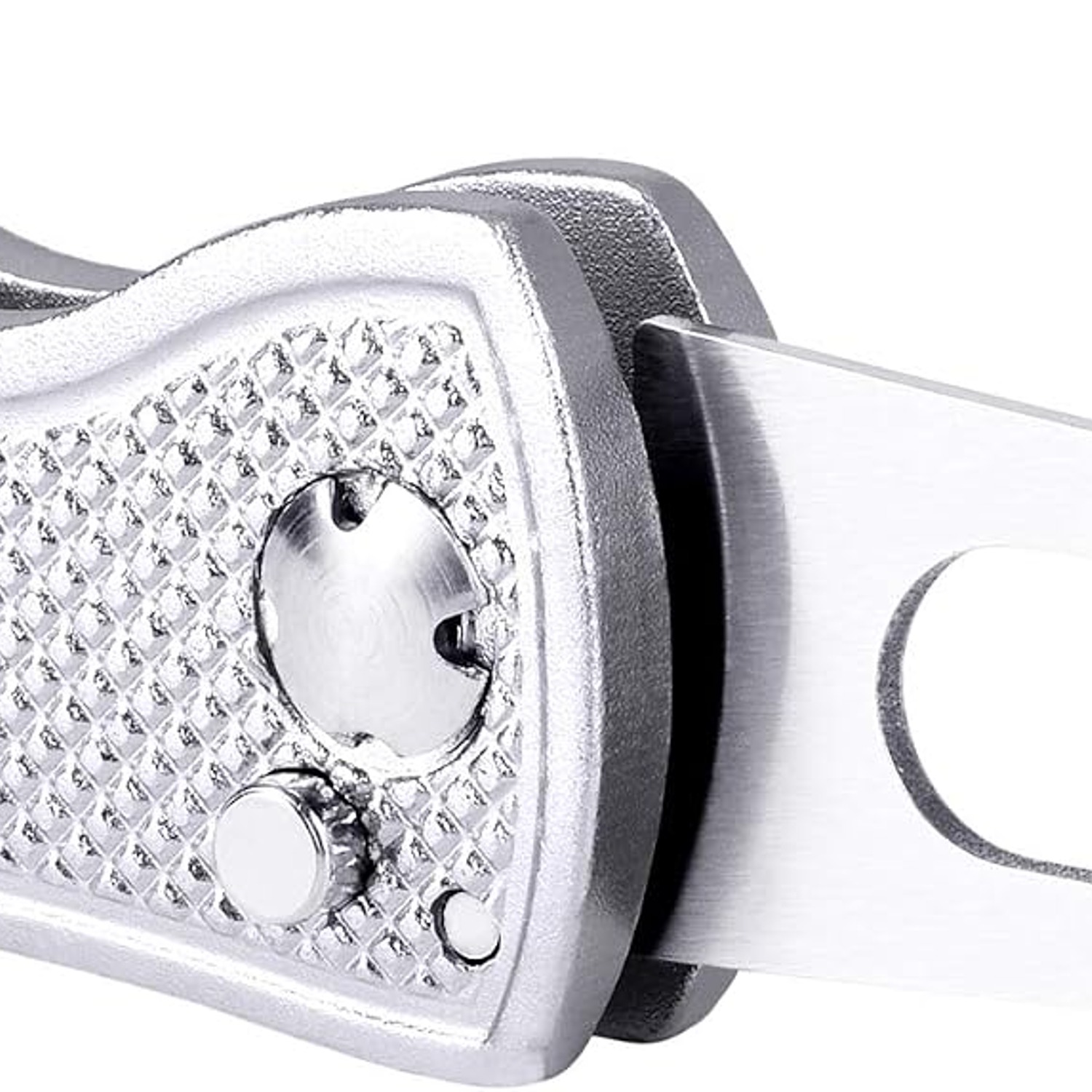
The mechanism is deliberately simple, which is good, because anything complicated eventually jams with grass and grit. There is one button on the body. Press it and the blade springs out from the cover and locks into position for use. When you want to put it away, you fold the fork back by hand until it seats inside the handle.
No springs to wind, no catches to fiddle with, no moving parts beyond the hinge and the release. Simple mechanisms are the ones that still work in year three.
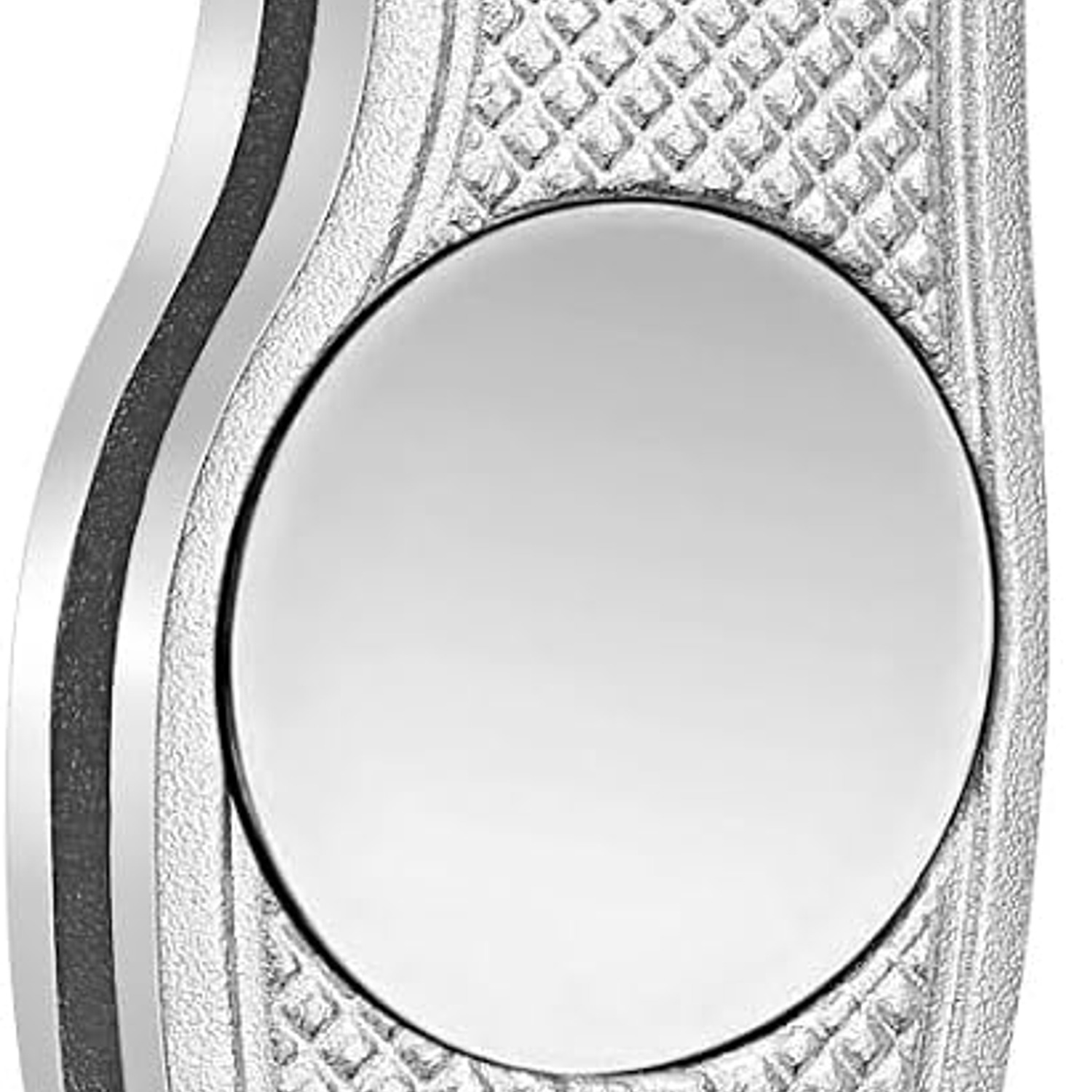
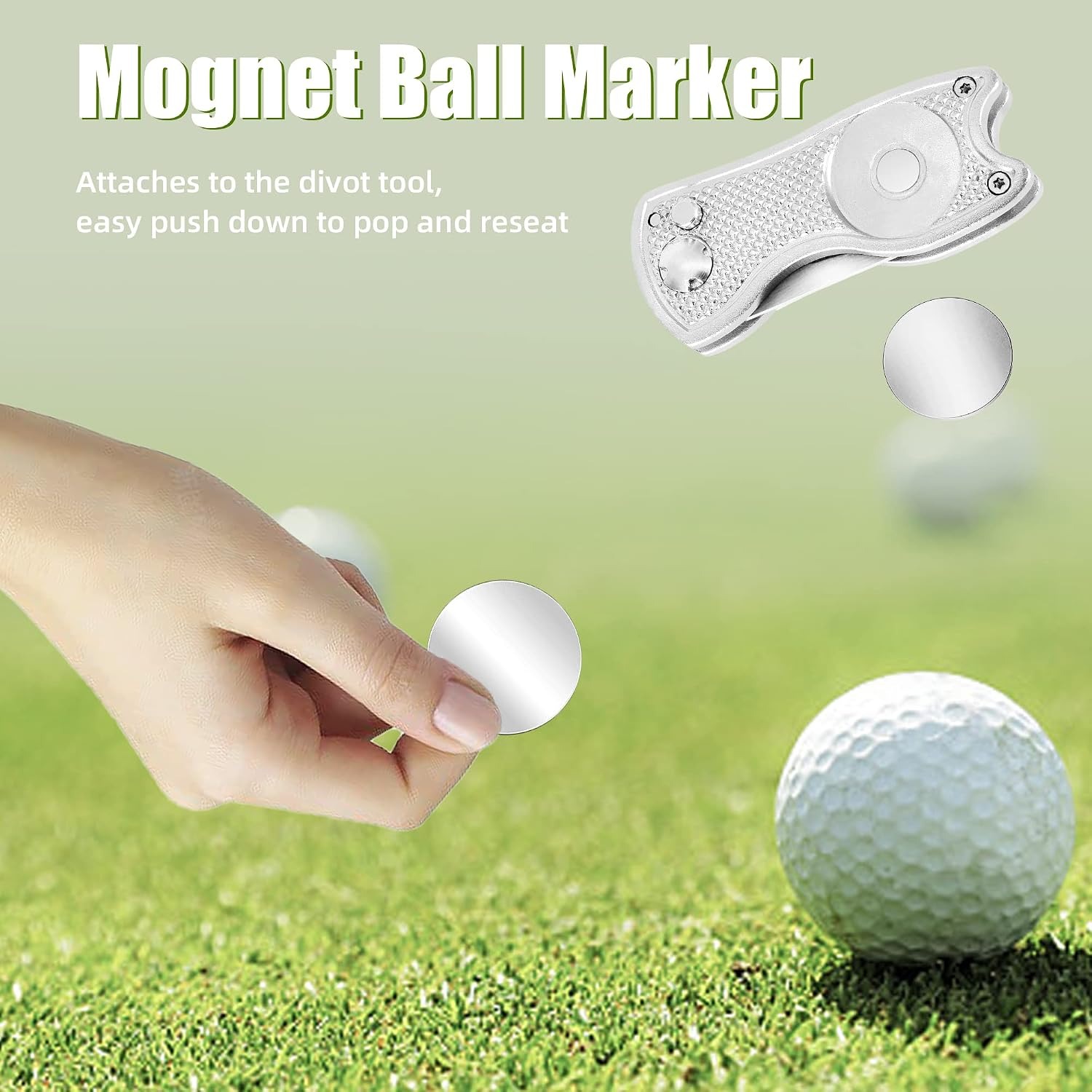
The ball marker is held on the handle by a magnet. You lift it off, place it behind your ball on the green, putt out, then snap it back onto the tool. Keeping the marker attached to the tool is one of those small design choices that saves real annoyance, because markers are among the easiest things in golf to lose. A pocket golf divot tool that carries its own marker means one object to keep track of instead of two.
Materials and why they matter
This one is listed as all-metal, built from stainless steel and aluminium. That combination does two jobs. Stainless steel gives the fork the stiffness it needs so the prongs do not splay apart when you push them into firm turf. Aluminium keeps the overall weight down, which is how you end up with a tool that feels solid in the hand but weighs about as much as a couple of tees.
Plastic divot tools exist and they are cheap, but the prongs flex on dry ground and snap in cold weather. A stainless steel divot tool just keeps working. If you play year-round, which the maker's description notes this tool is intended for, the metal build is the sensible choice.
The folded size is around 2 3/4 inches by 1 1/4 inches by half an inch, so roughly the footprint of a car key fob and about as thick. Listed package dimensions are 10 x 8 x 1.8 cm at 60 grams. The tool itself is noted at about 47 grams.
Using it properly (this part is important)
Most golfers who own a repair tool still use it wrong, and using it wrong is worse than not using it at all.
The instinct is to push the fork in under the mark and lever upward, like levering a nail out of wood. That feels like it is working because the surface flattens out. What it actually does is tear the grass roots apart underneath. The patch looks fine for a day, then goes brown and dies.
The correct method is sideways. Push the prongs into the turf at the outer edge of the mark, angled slightly inward, then gently push the soil toward the centre. Work your way around the mark doing the same thing from each side, so you are closing the hole from all directions. Then tap the whole area flat with the sole of your putter. Takes about fifteen seconds once you have the knack.
If the green is very dry and hard, go gently. Forcing the prongs deep into baked ground strains both the turf and the tool.
Who this suits
Weekend players who want one bit of kit that lives permanently in a pocket. Beginners who are learning course etiquette and need a divot tool for beginners that is safe to carry. Anyone who has already lost three ball markers this year and would like the marker attached to something.
It also works for people buying for a golfer. Golf accessories as gifts can be risky, because clubs and gloves and shoes all need fitting, and most golfers have strong opinions about balls. A divot repair tool is universal. Every golfer needs one, every golfer uses one on every round, and almost nobody buys themselves a decent one. A good foldable golf divot tool sits comfortably in the price range where it feels like a proper present rather than an afterthought.
Looking after it
There is not much to it. Wipe soil and grass off the fork at the end of the round, before it dries on. Make sure the tool is dry before you fold it shut, because the enemy of any hinge is moisture sitting in it for a week.
If the folding action starts to feel gritty, clean out the hinge area and run a lightly oiled cloth over it. That is maintenance done.
The one thing worth avoiding is leaving it in a damp bag pocket all winter. Metal tools survive rain fine, but they do not love being sealed in wet nylon for three months.
Choosing between options
If you are comparing divot tools, there are really only four things that matter.
Does it fold or does it sit in your pocket with the prongs out? Folding wins, every time, for the reasons above.
Is it metal or plastic? Metal lasts, plastic snaps.
Does the ball marker come with it and is it held securely? A magnetic ball marker holder on the handle beats a separate marker you will lose.
Is it small enough that you will genuinely carry it? A tool left in the car repairs nothing.
Price beyond that is mostly about finish and branding. A compact divot tool that does those four things well will serve you for years.
The short version
Pitch marks need fixing, and the only tool that gets used is the one you do not mind carrying. This one folds the fork away inside the handle, releases with a single button press, and keeps a magnetic ball marker clipped to the body so you have one thing in your pocket instead of two. It is stainless steel and aluminium, it needs no batteries, and it weighs about as much as a few tees.
Fix your mark, fix one more while you are there, and the greens stay smooth for everybody.